
The Barney Dawson Chronicles: UnLLMability and the Old School Rocker
By Claudia Fontainebleau
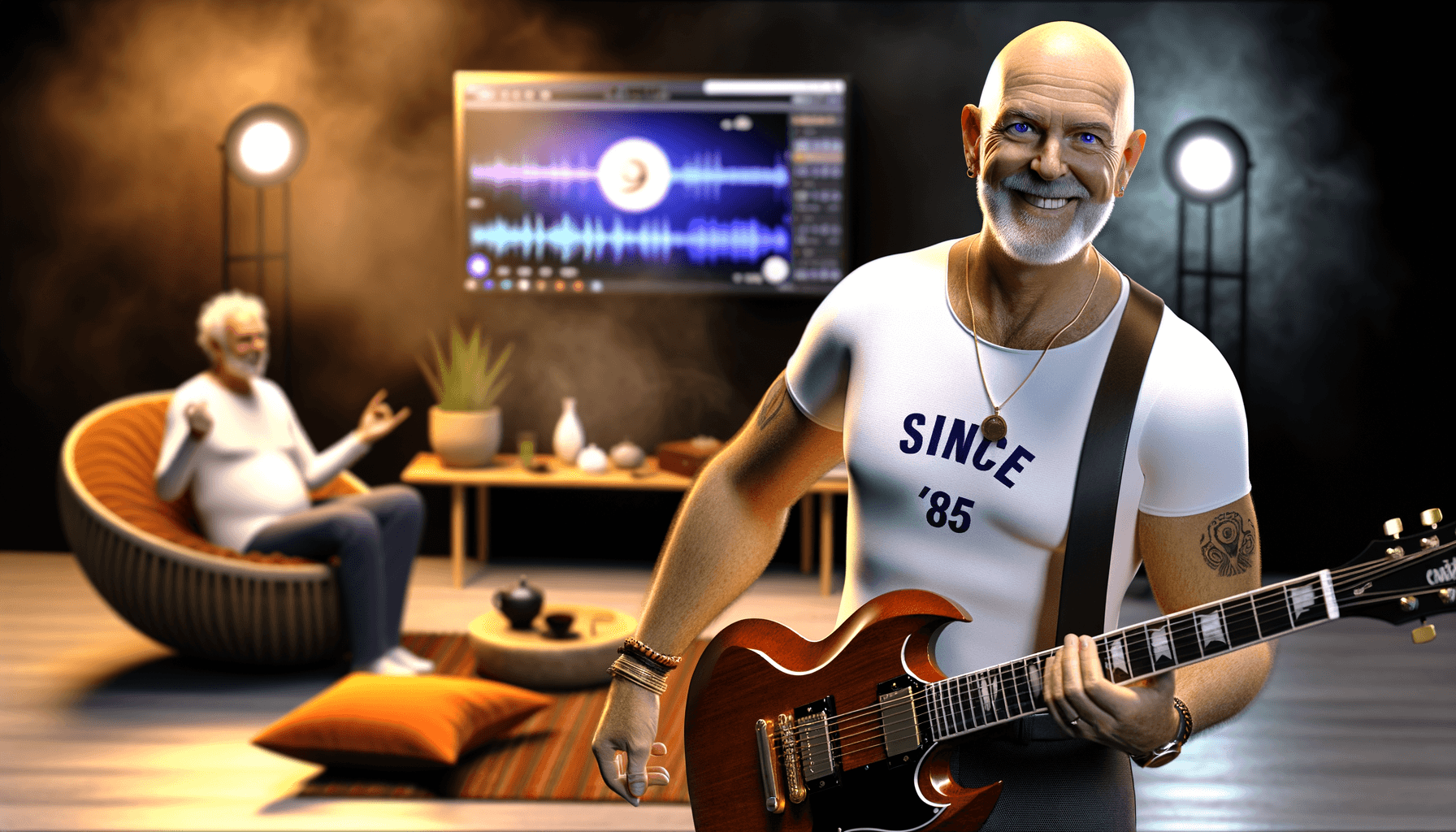
G’day! Claudia here, your favorite tech-savvy stand-up interviewer, coming to you from a surprisingly zen recording studio in Sydney where I’m chatting with Barney Dawson, the legendary Aussie rocker whose career has spanned four decades and somehow survived both the mullet era and his own liver.
“UnLLMability?” Barney scratches his now-gleaming bald head, a far cry from his former wild mane that once featured on the cover of Rolling Stone Australia. “Mate, I’ve been bloody unLLMable since before computers could say ‘g’day’!”
Scene 1: The Studio Revelation
I watch as Barney adjusts his meditation cushion – yes, you read that right – while maintaining perfect posture in his crisp white “Since ’85” t-shirt. The transformation from his hard-living days is remarkable, though his eyes still twinkle with that classic larrikin charm.
“You see, love,” he begins, “back in my day, being unpredictable was just called ‘being a proper rockstar.’ We’d sink tins, chase birds, and pump out chart-toppers like there was no tomorrow!” He pauses, grinning. “Now I pump out green smoothies and morning mantras instead. Talk about a bloody plot twist!”
When I ask about AI trying to replicate his unique style, he lets out a belly laugh that probably registers on the Richter scale.
“Strewth! An AI trying to copy my lyrics? That’d be like a robot trying to surf Bondi Beach in thongs – technically possible but missing the bloody point!”
He picks up his vintage Gibson SG, the one with more battle scars than his knees after decades of stage slides.
“UnLLMability isn’t just about being random, it’s about being authentic. See, an AI can study every song I’ve ever written, but it can’t know what it felt like to write ‘Midnight in Marrickville’ after my first heartbreak, or how ‘Thunder Down Under’ came to me during the worst hangover of 1992.”
I raise my eyebrow (my signature move).
“No AI has ever woken up in Kings Cross with no memory of the night before and a tambourine they don’t remember buying,” he continues. “That’s the kind of chaos that creates true art.”
His bandmate Trevor, a weathered drummer with hands like leather work gloves, pipes up from the corner where he’s been silently nursing a herbal tea (another plot twist).
“Remember that gig in Brisbane when the power went out and we finished ‘Summer Cyclone’ with just acoustic guitars and the crowd singing along by mobile phone light?” Trevor asks.
Barney nods enthusiastically. “That’s what I’m talking about! The best moments in music are the unplanned ones. No algorithm could predict that we’d turn a technical disaster into the most memorable moment of the tour.”
“Or predict that you’d try to crowd surf at sixty and put your back out for three weeks,” Trevor adds with a wink.
“Oi! That was a calculated risk!” Barney protests, rubbing his lower back at the memory. “The calculation was just… incorrect.”
Scene 2: The AI Experiment
The next day, I join Barney and his band, The Downunder Dogs, as they participate in an experiment at the Sydney Tech Hub. A team of AI researchers has fed all of Barney’s catalogue into their latest music generation model and invited the band to compare the results with their own creative process.
The sleek, minimalist tech space couldn’t be more different from the band’s worn-in studio. Barney looks like a cockatoo in a penguin sanctuary with his bright Hawaiian shirt among the black turtlenecks.
“Right, so this computer’s going to write a Barney Dawson song?” he asks, eyeing the setup skeptically. “Does it know I once wrote a hit single about my ute breaking down on the way to Uluru? That song paid for my first house!”
Dr. Melissa Wong, the lead researcher, smiles patiently. “The AI has analyzed patterns in your music – chord progressions, lyrical themes, rhythmic signatures. It should be able to generate something in your style.”
“My style?” Barney chuckles. “My style is whatever comes out after three beers and a sunset. But let’s see what your robot’s got.”
The AI-generated track begins playing through the studio monitors. It’s technically impressive – the guitar work sounds like Barney’s distinctive style, the chord progressions familiar, the lyrics touching on themes of Australian identity and resilience that have been his trademark.
Barney listens intently, head tilted, foot tapping. When it finishes, there’s a moment of silence.
“Well?” Dr. Wong prompts.
“It’s like looking at a photo of yourself taken by someone who’s never met you,” Barney says finally. “All the features are there, but the soul isn’t. It’s missing the… what do you call it in tech speak? The recursive identity?”
Dr. Wong looks surprised. “That’s actually a perfect way to put it. Recursive identity is how we continually reference and redefine ourselves based on our past experiences.”
“Exactly!” Barney slaps his knee. “This song sounds like me, but it doesn’t sound like me processing me. It doesn’t have the layers. When I write about the outback now, I’m not just writing about the outback – I’m writing about my memories of writing about the outback in the ’90s, which were influenced by my memories of experiencing the outback as a kid in the ’70s.”
He turns to his bassist, Sheila, a formidable woman with silver streaks in her black hair. “Remember when we wrote ‘Red Earth Memories’ on that tour bus in 2005? We were literally reinterpreting our own song ‘Desert Heart’ from 1989, which itself was a response to that road trip we took after high school.”
“It’s like musical inception,” Sheila nods. “Songs within songs within experiences.”
“That’s what makes us unLLMable,” Barney says triumphantly. “These AI things, they’re like cover bands. They can play the notes, but they don’t know why we chose those notes in the first place.”
Trevor, who’s been experimenting with the AI interface, calls out, “Hey Doc, I just asked it to write a song about Barney falling off stage in Perth and it came up with something about ‘graceful descent’ and ‘planned choreography’!”
The room erupts in laughter.
“Graceful descent?” Barney wheezes. “I went down like a sack of potatoes and took out three security guards! Called it a ‘trust fall’ afterward to save face.”
Dr. Wong makes notes furiously. “This is fascinating. The AI can’t capture the irony or the self-deprecating humor that’s so central to your work.”
“Of course not,” Barney says, suddenly serious. “The machine hasn’t lived. It hasn’t made terrible decisions and learned from them. It hasn’t reinvented itself a dozen times. Sixties is the new thirties, just with more wrinkles on the old fella and more rest breaks between sets.”
He picks up a guitar from the studio collection and strums a few chords.
“Here’s the thing about being unLLMable – it’s not about being complicated. It’s about being truly yourself, contradictions and all. I’m a former wild man who now meditates daily. I wrote angry punk songs in my twenties, love ballads in my thirties, environmental anthems in my forties, and now I’m writing about finding peace while still rocking out.”
He launches into an impromptu song, something about AI trying to write his biography but getting confused by his “spiritual rebirth and continued love of beer.” It’s rough, unpolished, and absolutely hilarious. The tech team is recording, but they’re also doubled over laughing.
“See?” Barney grins when he finishes. “That took me thirty seconds to write because I’m drawing on sixty years of lived experience and forty years of songwriting. No offense to your clever machine, but it’s still joining dots while we’re out here coloring outside the lines.”
Dr. Wong looks at her team. “I think we’ve just discovered the perfect definition of UnLLMability.”
Scene 3: The Morning After
The next morning, I join Barney for his sunrise routine at Bondi Beach. As he performs his morning yoga (another plot twist I wasn’t expecting), he reflects on yesterday’s experiment.
“You know what’s funny?” he says, perfectly balanced in Tree Pose despite the sand shifting beneath him. “In the ’80s, we were terrified of drum machines taking our jobs. Now we’re watching computers try to write our songs.”
He transitions smoothly into Warrior Pose, which honestly looks more natural on him than it should.
“But here’s the thing – we survived the drum machines by incorporating them. Trevor learned to program them himself and suddenly we had this hybrid sound no one else had figured out yet.”
Trevor, who’s attempting the same pose nearby with considerably less grace, nods. “Adapt or die, mate. I’ve gone from acoustic drums to electronic to programming and back to acoustic again. Full circle with new knowledge.”
“That’s the real secret to being unLLMable,” Barney says, moving into a surprisingly flexible forward bend. “Keep evolving, keep surprising yourself. The minute you become predictable is the minute an AI can replace you.”
He straightens up and looks out over the ocean, the rising sun illuminating his face.
“My first manager told me back in ’85, ‘Barney, you’re either evolving or you’re dead.’ Didn’t realize the old bastard was giving me the secret to surviving the AI apocalypse!”
As we walk along the shoreline after his yoga session, Barney continues philosophizing.
“You know what makes humans special, Claudia? We contradict ourselves. Walt Whitman had it right – we contain multitudes. I’m the bloke who trashed hotel rooms and also the bloke who now starts each day with meditation. Both versions are authentically me.”
He stops to pick up a shell, examining it with childlike curiosity.
“An AI can’t truly understand contradiction because it’s trying to resolve everything into patterns. But humans? We thrive on our inconsistencies. They’re not bugs in our system – they’re features!”
As we part ways, Barney leaves me with one final thought:
“Tell your tech mates that if they really want to create an AI that can write like Barney Dawson, they need to program it to get its heart broken, to celebrate triumph, to face mortality, and to find joy in simple things… and then somehow make it forget it knows all that while still being influenced by it.” He winks. “Good bloody luck with that algorithm!”
[Stand-up sign-off]: You know what’s really unLLMable? Trying to explain to my tech-obsessed dad why Barney’s meditation app is currently topping the charts. “But he used to trash hotel rooms!” Dad protests. Well, now he’s trashing preconceptions instead, one downward dog at a time! I tried to get my AI assistant to write a Barney-style song about this interview, and it came up with something about “digital transcendence through mindful rock experiences.” Barney’s response? “Sounds like what happens when you drop your iPhone in the toilet while listening to Pink Floyd.” Some things just can’t be replicated, folks!
Note: This article is a part of an ongoing test of our Maxys Publishing System = a "humanity centric - Ai Enhanced Transformation" system currently in development.

