
Strumming Against the Machine: Barney Dawson’s Quest to Control the Narrative
Introduction
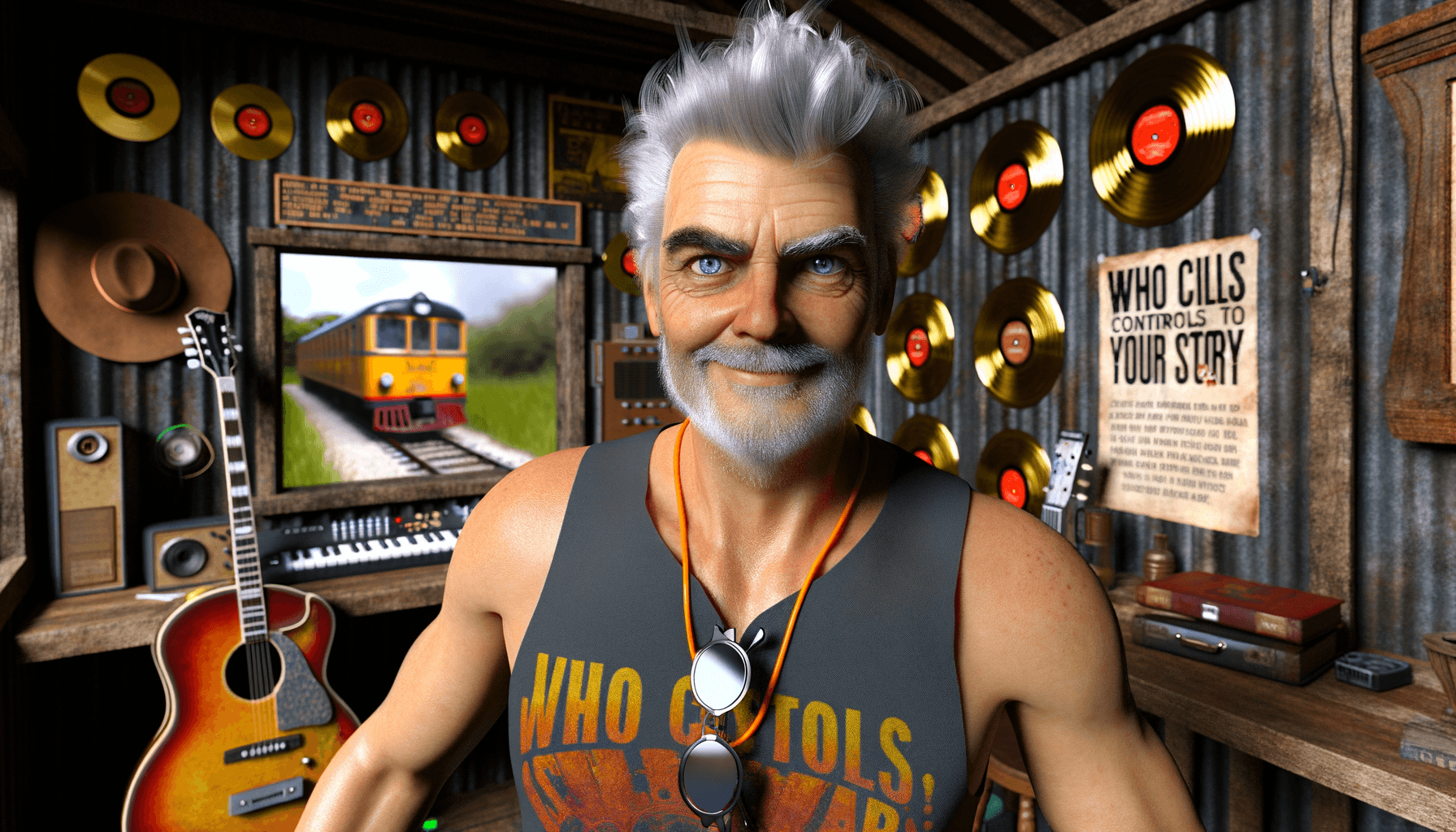
I’m sitting in what Barney Dawson calls his “executive boardroom” – a weathered garden shed at the bottom of his sprawling Sutherland Shire property, adorned with gold records, vintage guitars, and a surprising number of inspirational quotes printed from Pinterest. The legendary 60-year-old musician adjusts his reading glasses, which hang precariously from a fluorescent orange cord around his neck (“So I can find the bloody things when I’m swimming at Cronulla”).
“You know what grinds my gears about this whole narrative control business?” Barney says, taking a theatrical swig from his kombucha (a recent health kick that followed what he describes as “a come-to-Jesus meeting with my liver specialist”). “Everyone’s so worried about AI taking over music, but mate, record executives have been controlling the narrative since Elvis first wiggled his hips!”
Barney Dawson – former frontman of 80s pub rock legends The Battered Savs and current patriarch of roots-rock outfit The Silver Tsunamis – has become an unlikely voice in the debate around artificial intelligence and artistic authenticity. His viral TikTok rants about “robot songwriters” have garnered millions of views and turned him into what his 28-year-old daughter calls “an accidental influencer for the denture cream demographic.”
“I didn’t mean to become the poster boy for technophobic baby boomers,” he chuckles, running a hand through his impressively full silver mane. “I just asked a simple question online: If AI can write a song that sounds like The Battered Savs, does it get royalties for my divorce settlements too?” He slaps his knee at his own joke, nearly spilling his kombucha.
The shed walls vibrate as a freight train rumbles past his property. “That’s the 3:15 to Central,” he notes with the precision of someone who’s lived beside the tracks for decades. “Keeps me grounded. No algorithm can replicate the feeling of your coffee cup dancing across the table at the same time every day.”
Barney’s journey into the digital discourse began last year when a music tech startup used his band’s back catalogue to train an AI that could generate “new” Battered Savs songs. The results were uncannily accurate – capturing his distinctive growl, the band’s three-chord progressions, and even their penchant for lyrics about Holden utes and heartbreak at the RSL.
“They showed me this computer-generated track called ‘Saturday Night at the Bowlo’ and I nearly fell off my chair,” Barney recalls, widening his eyes for dramatic effect. “It sounded exactly like something I would’ve written after ten schooners and a punch-up in the car park. The scary part? I was stone-cold sober when I heard it, and I still thought it was a banger!”
Instead of launching a lawsuit, Barney did something unexpected – he invited the tech team to collaborate with The Silver Tsunamis on their new album. “Everyone expected me to go full Luddite and start smashing computers with my guitar. But listen, I’ve survived disco, grunge, boy bands, and my second wife’s brief country music phase. Adaptation is how dinosaurs like me stay relevant.”
The cramped rehearsal space above Cronulla Bowls Club smells of decades of spilled beer, cigarette smoke, and what Barney calls “the sweet perfume of rock ‘n’ roll dreams deferred.” The Silver Tsunamis – comprising Barney, his longtime drummer “Sticks” Malone (63), bassist Wendy “The Wallet” Chen (58, and the band’s reluctant financial manager), and suspiciously youthful keyboardist Zack (either 32 or 45, depending on which band member you ask) – are midway through rehearsing a new track.
“This one’s called ‘The Algorithm Ate My Homework,'” Barney announces, adjusting his guitar strap emblazoned with faded Australian flags. “It’s our attempt to understand how the bloody machines are taking over everything from songwriting to deciding what underwear ads follow me around the internet.”
The band launches into what can only be described as a surprisingly catchy blend of traditional Aussie rock and electronic elements. Barney’s gravelly voice delivers lines like: “Your data’s being harvested while you’re scrolling through your phone / The AI knows you better than the people you call home / But it can’t tell you’re crying when you’re listening alone.”
When they finish, Wendy adjusts her bass and sighs. “That’s the third song about technology this session. Remember when all our songs were about getting drunk and chasing sheilas?”
“Evolution, Wends!” Barney exclaims, pointing a calloused finger skyward. “Besides, now we write about getting drunk, chasing sheilas, AND the existential threat of digital overlords. It’s called range, darling.”
Sticks, who has remained characteristically quiet throughout rehearsal, finally speaks up. “You know what’s ironic? We’re writing songs about the dangers of AI controlling the narrative, but we’re using Barney’s viral fame to control our own narrative. We’re getting more gigs now than when we were forty!”
This philosophical observation hangs in the air until Barney breaks the silence: “Sticks, that’s the most words you’ve strung together since 1997. Write that down, Zack – it might make a good bridge for the next song!”
Zack, hunched over a laptop that seems permanently attached to his keyboard setup, nods distractedly. “Already fed it into the lyric generator app,” he mumbles.
Barney freezes mid-guitar adjustment. “The what now?”
The room temperature seems to drop several degrees as Zack realizes his slip. “Just kidding, boss,” he backpedals unconvincingly. “Old-school songwriting all the way.”
Barney narrows his eyes but lets it slide. Later, as the band packs up their equipment, he confides in me. “Of course I know Zack uses those AI tools. I’m not an idiot. I just like watching him squirm.” He winks conspiratorially. “The truth is, half the arrangements on our last EP came from this music AI thing he showed me. I told him it was cheating, then spent three hours that night playing with it myself. Wrote a bloody sea shanty about my prostate exam!”
Back at his home the following day, Barney shows me his surprisingly sophisticated home studio. “My third ex-wife got the investment property in Terrigal, I got this,” he says, gesturing around the room with a mixture of pride and lingering divorce bitterness. “Honestly, I reckon I got the better deal.”
As he fiddles with various knobs and sliders on his mixing desk, I ask him about the apparent contradiction: publicly railing against AI in music while privately embracing it.
“Look,” he says, suddenly serious, “my issue isn’t with the technology itself. It’s with who controls it. For forty years, I’ve watched the music industry squeeze artists like overripe oranges, taking most of the juice for themselves. Now they’ve got these fancy algorithms deciding what songs get promoted, what sounds are ‘trending,’ what artists fit the right profile.”
He spins in his studio chair, suddenly animated. “Did you know streaming platforms can literally predict what songs will be hits based on their first week’s performance? They’re controlling what becomes popular before we even have a chance to decide for ourselves!”
Barney pulls up a track on his computer. “This is a song we released last year. Got buried because it didn’t fit the ‘profile’ of what’s supposedly popular. Meanwhile, some teenager making bedroom pop about their Uber Eats delivery gets millions of plays because the algorithm favors it.”
The track plays – a hauntingly beautiful ballad about growing older in a country that’s changing too fast. It’s genuinely moving, showcasing a vulnerability rarely associated with Barney’s public persona.
“So yeah, I’ll use the technology when it serves the art,” he continues as the song fades. “But I won’t let it or the corporate suits behind it tell me what art should be. That’s the narrative I’m fighting to control.”
He leans back, crossing his arms over his “Rockstars Do It Till They Need Hip Replacements” t-shirt. “Besides, the ultimate irony is that by becoming the old man yelling at the AI cloud, I’ve actually gained more control over my career than I’ve had in decades. Got a new generation listening to my music, promoters calling again, and even got offered a judging spot on one of those singing shows.”
“Did you take it?” I ask.
“Told them I’d rather have a colonoscopy without anesthetic,” he cackles. “Some narratives aren’t worth controlling!”
As our interview winds down, Barney walks me to my car, philosophizing about the future. “You know what keeps me up at night? Not that AI will replace musicians – we survived drum machines and autotune, we’ll survive this too. What worries me is that we’re letting algorithms decide what emotions are marketable. Music has always been about feeling something authentic, even if it’s uncomfortable. I don’t want to live in a world where an AI determines which human emotions are trending this week.”
He pauses by my car door, suddenly looking every bit his sixty years. “But then again, I never wanted to live in a world where people take pictures of their breakfast or where my ex-wife Karen runs off with her Pilates instructor, yet here we are.” The melancholy vanishes as quickly as it appeared, replaced by his trademark grin. “Life finds a way, and so do cranky old musicians.”
As I start my engine, Barney taps on the window with one final thought: “You know what’s funny about trying to control the narrative? The moment you think you’ve got a grip on it, life throws you a plot twist. Just ask my fourth wife… actually, better not. She’s still got a restraining order.”
Well, that’s Barney Dawson for you – equal parts philosopher, rockstar, and walking dad joke. Speaking as someone who once tried to control my own narrative by claiming I was “just resting my eyes” during a Zoom meeting with my boss, I can relate. Remember folks, in the battle between humans and algorithms, the best strategy might be learning when to play unpredictably. It’s like my stand-up bit about dating apps – the algorithm might suggest your perfect match, but it can’t predict that they collect toenail clippings or think pineapple belongs on pizza. Some horrors, you just have to discover the old-fashioned way!

